
Building a competitive graphics card from scratch is like trying to build a commercial airplane in your garage. The odds of success are near zero. The modern GPU market is a brutal monopoly dominated by a few massive corporations with decades of research behind them.
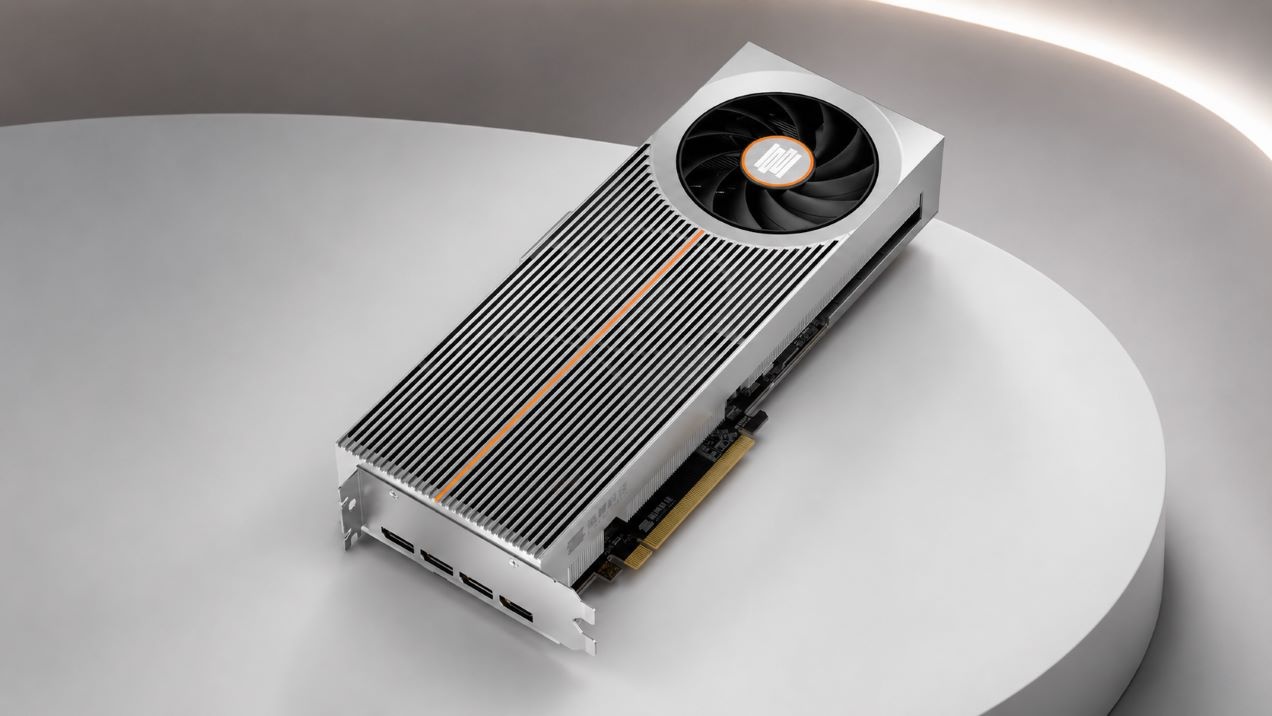
But a Chinese hardware company named Lisuan just released the LX 7G100. It is a desktop gaming graphics card built entirely on their own custom TrueGPU architecture. It boots up, runs modern PC games, and even earned Microsoft WHQL driver certification.
This is a massive engineering win for China’s domestic tech push. But for anyone actually looking to play games, the math just does not work out.
The actual performance numbers
The Lisuan LX 7G100 GPU comes with 12GB of GDDR6 memory, a 6nm chip known internally as the 7G106, and full support for DirectX 12. Under the hood, the silicon features 192 texture mapping units and 96 raster operations pipelines on a 192-bit memory bus. It even includes modern media capabilities like hardware-accelerated AV1 encoding, which is a huge deal for video editors and streamers.
The physical card itself feels premium. The initial Founders Edition run is limited to just 1,000 units in China, each bearing a unique serial number. It runs on a PCIe 4.0 interface and includes four DisplayPort 1.4a outputs, supporting 8K displays at 60Hz. On paper, it looks exactly like something you would buy from a major Western brand.
Reviewers in China recently got their hands on the card and ran it through standard gaming benchmarks to see if it could survive real-world use. The results are totally playable. At 1080p resolution, the card hits 56 frames per second in Black Myth: Wukong. It manages around 88 frames per second in Cyberpunk 2077 with frame generation turned on. If you want to play older or less demanding titles like Dota 2, it easily pushes past 180 frames per second.
For a brand new architecture, hitting these numbers on day one is a huge achievement. Previous Chinese GPUs like the Moore Threads S80 struggled to even launch games without crashing. Buyers had to wait months for simple driver patches just to get basic titles running. Lisuan bypassed that miserable phase entirely. Modern games load up and run.
But raw performance is only half the story. The card performs similarly to an Nvidia RTX 3060. That was a great mid-range card half a decade ago. Today, it feels slow. The hardware also completely lacks ray tracing support. Lisuan has promised to add ray tracing in future generations, but right now, you are stuck with standard rasterization.
A pricing strategy that ignores reality
The biggest problem with the LX 7G100 is the price tag. Retail units are selling for around 3,300 RMB in China, which translates to roughly $485.
That price is completely disconnected from the current market reality. For nearly $500, you can buy a current-generation Nvidia graphics card like the RTX 5060 Ti or an Intel Arc B580. Either of those cards will deliver two to three times the frame rates of the Lisuan card while using less power and offering far better software features.
If Lisuan priced this card at $150, it would be a compelling budget option for 1080p gamers. At $485, it is basically a novelty item for collectors or a mandated purchase for government-backed system builders in China. You are paying current-generation prices for five-year-old performance.
Even the enthusiast market in China is struggling to justify the cost. Reviewers have pointed out that early adopters are essentially paying a massive premium to act as beta testers for the company’s first hardware release.
| 1080p Gaming Results, Average FPS / 1% low | |||||
|---|---|---|---|---|---|
| Chaowanke (Game) | Settings | LX 7G100 | RTX 4060 | Arc B580 | Radeon RX 6600 XT |
| Cyberpunk 2077 | Preset + FSR3 Quality + frame generation | 88 / 70 | 232 / 164 | 243 / 183 | 220 / 185 |
| Black Myth: Wukong | Medium + FSR3 63 | 56 / 41 | 115 / 94 | 81 / 60 | 98 / 80 |
| Shadow of the Tomb Raider | Medium + TAA | 71 / 46 | 176 / 137 | 182 / 131 | 159 / 124 |
| Forza Horizon 5 | Low preset | 48 / 18 | 228 / 189 | 240 / 200 | 262 / 215 |
| Horizon Forbidden West | Medium + FSR3 60 + frame generation | 79 / 30 | 144 / 86 | 165 / 95 | 139 / 86 |
| Red Dead Redemption 2 | Medium settings | 51 / 28 | 181 / 130 | 106 / 50 | 172 / 126 |
| The Witcher 3 | Medium preset | 57 / 46 | 107 / 93 | 132 / 116 | 76 / 68 |
| GTA V Enhanced | High + FSR3 Quality + frame generation | 150 / 109 | 314 / 116 | 272 / 85 | 290 / 228 |
| Elden Ring | Medium preset | 80 / 37 | 166 / 129 | 142 / 109 | 172 / 137 |
*Data Source: Chaowanke on YouTube
Driver software is the real test
The most important detail about this launch is not the frame rates or the memory speed. It is the Microsoft WHQL certification.
Getting certified by Microsoft means Lisuan built a stable, recognized driver ecosystem. Hardware is useless without software that knows how to talk to the operating system. By clearing this hurdle, Lisuan proved they have a functional software stack. They are not just printing silicon and hoping for the best.
This lays the foundation for their future generations. Developing drivers from scratch takes years of painful trial and error. The current software still has plenty of rough edges. Reviewers noted that the control panel is painfully bare, overclocking settings reset every time you reboot the computer, and some games suffer from noticeable frame pacing issues.
But the baseline exists. Now that the core software functions, Lisuan can focus their massive resources on improving their actual hardware architecture for the next release.
What this means for the global GPU market
Nvidia, AMD, and Intel are not going to lose sleep over the Lisuan LX 7G100 GPU today. The performance gap is simply too wide. But dismissing this launch would be a mistake.
The goal for Chinese tech companies is not to beat Nvidia tomorrow. The goal is hardware independence. They want to reach a point where domestic data centers, government computers, and eventually consumers do not need to rely on Western silicon. The LX 7G100 proves that they can build a functional, modern consumer graphics card without relying on outside architectures.
If you are building a budget gaming PC right now, ignore the LX 7G100 entirely. Look for a discounted RTX 4060 or check the used market for an RTX 3060 if you want that specific level of 1080p performance for under $200. You will save hundreds of dollars and avoid the headache of early-adopter driver bugs.
China’s domestic GPU industry is moving fast. They are still years behind the heavyweights, but they are no longer stuck at the starting line. The next iteration might actually force the big brands to pay attention.